



In May 2025, Dr. Mariangela Hungria, a renowned Brazilian soil microbiologist, was named the 2025 World Food Prize Laureate—an honor widely regarded as the “Nobel Prize for Agriculture.” Over four decades, she has pioneered the use of naturally occurring nitrogen-fixing soil microorganisms to replace costly, polluting synthetic nitrogen fertilizers, helping transform Brazil into a global breadbasket while saving billions of dollars annually and drastically cutting greenhouse gas emissions.
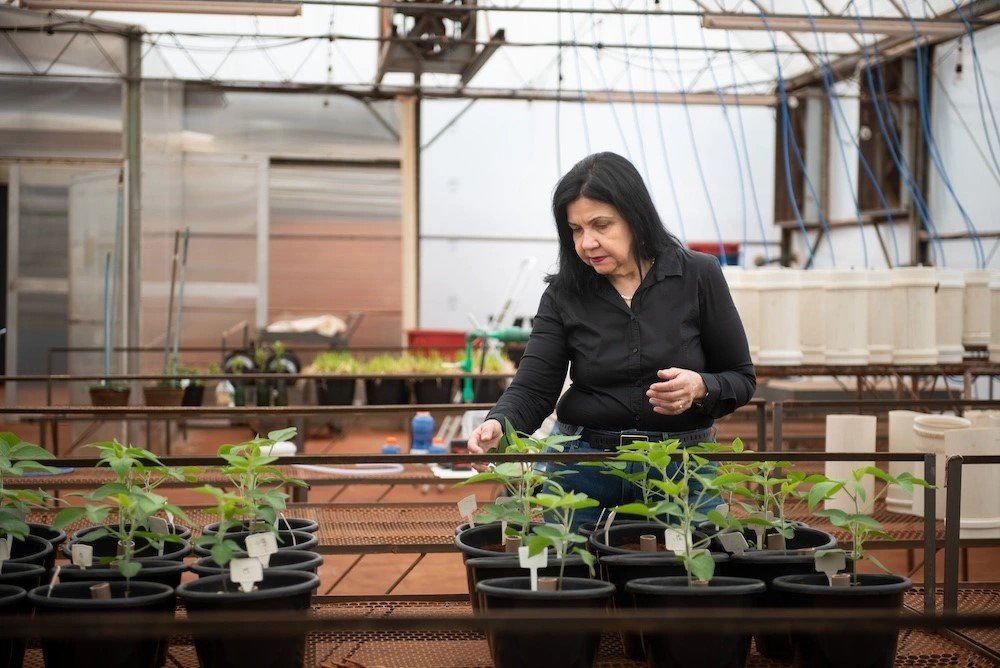
Source: World Food Prize Foundation Media Library
The Nitrogen Dilemma: The Double-Edged Sword of Chemical Fertilizers
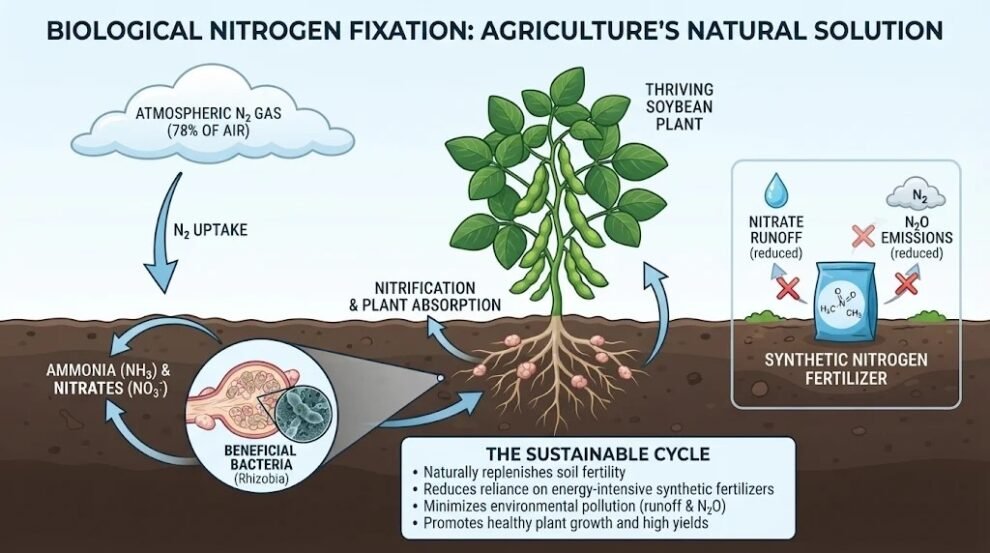
Nitrogen is a fundamental building block for plant proteins and chlorophyll. Although nitrogen gas ($N_2$) makes up roughly 78% of Earth’s atmosphere, most crops cannot absorb it directly. For the past century, global agriculture has relied heavily on energy-intensive synthetic nitrogen fertilizers. Yet more than half of applied chemical fertilizer often leaches into waterways or volatilizes into the air, causing water pollution, soil degradation, and emissions of nitrous oxide ($N_2O$), a potent greenhouse gas.
Underground “Micro-Fertilizer Factories”: Biological Nitrogen Fixation & Co-Inoculation
Legumes such as soybeans form an intricate symbiosis with soil bacteria called rhizobia—plants provide sugars and shelter inside root nodules, while the bacteria act as microscopic factories converting atmospheric nitrogen into plant-usable ammonia. Working at Embrapa, Dr. Hungria launched more than 30 microbial technologies and pioneered “co-inoculation”—combining rhizobia with Azospirillum brasilense to stimulate denser root hairs and double yield gains in soybeans and common beans. Today, over 70 million doses are sold annually in Brazil across more than 40 million hectares, saving an estimated \$40 billion in fertilizer costs.
The “Guardian of the Soil” Who Read Microbe Hunters at Age Eight
A Childhood Book That Sparked a Lifelong Calling
In 1966, in a small town in São Paulo state, eight-year-old Mariangela unwrapped a gift from her grandmother: Paul de Kruif’s classic science book Microbe Hunters. She stayed up all night reading about scientists unlocking invisible worlds. By morning, her mind was made up—she would become a soil microbiologist dedicating her life to fighting hunger.
Breaking Ground in a Male-Dominated Field
When she entered the Luiz de Queiroz College of Agriculture at the University of São Paulo in the late 1970s, soil science was male-dominated and fertility was defined strictly by chemicals. Even her teachers urged her to choose another path, yet she graduated third in her class, caught the attention of agricultural microbiology pioneer Dr. Johanna Döbereiner, and earned her Ph.D. under Döbereiner’s mentorship.
A Rigorous Scientist and Champion for Women in Agriculture
To date, she has published over 500 scientific papers, received Brazil’s Grand Cross of the National Order of Scientific Merit and the 2020 TWAS-Lenovo Science Award, and tirelessly mentored young women in science. As she stated at the 2025 ceremony: “I always believed in the life in soil, in microorganisms restoring fertility, in highly productive agriculture that does not harm the environment.”
The World Food Prize is widely regarded as the “Nobel Prize for Food and Agriculture,” serving as the foremost international honor recognizing individuals who have advanced human development by improving the quality, quantity, or availability of food.
Conceived in 1986 by Nobel Peace Prize laureate and “Father of the Green Revolution” Dr. Norman Borlaug, the annual award grants laureates a $500,000 monetary prize alongside a commemorative sculpture to inspire global pioneers in the fight against hunger. Through the enduring philanthropy and endowment of John Ruan and the Ruan family, the World Food Prize Foundation established its permanent home in Des Moines, Iowa—Dr. Borlaug’s home state and the agricultural heartland of the United States—cementing the region as a premier global hub for food security innovation



Add Comment